
Even though the NHL season is in the midst of the Stanley Cup Playoffs, it’s not too early to think about the off-season festivities of the NHL draft and free agency. One of the unique features of the NHL is that it is the most cap constrictive sport. This is in part because of three features: (1) the presence of a hard salary cap, (2) the nature of guaranteed contracts and (3) limited and no-trade clauses. The combination of these three factors separate the NHL from other leagues, namely the MLB, NFL and NBA. Other leagues have mechanisms for restructuring contracts, the lack of guaranteed money and/or soft salary cap restrictions.
How this translates to differentiate the NHL from other leagues is that the salary cap is the great equalizer, which can empower or impoverish a franchise with a few decisions. Aside from the compliance buyouts offered in the wake of the previous CBA, there are limited options for a team to jettison a player signed to a bad contract. Teams that sign players to long-term, big money contracts are held most accountable in the NHL, with limited options of movement that can hamstring a franchise for years.
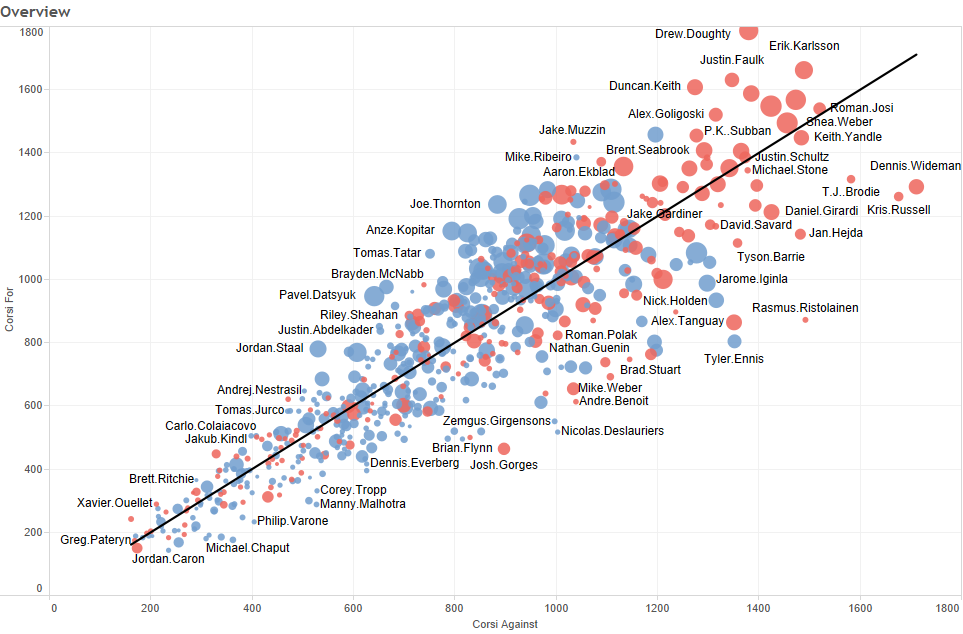
Thanks to war-on-ice.com, I was able to analyze the relationship between Corsi values (shots taken for/against while on the ice/off the ice) and annual contract values for players. First, I map the Corsi for (herein CF) and Corsi against (herein CA) values on a (x,y) plot. The size of the bubbles (for each player) are relative to the value of their contract.

 Ice Analytics