Articles

GAR and Cap Hits (Part 2 of 3)

Following up from part one of the series, part two of the ‘GAR and Cap Hits’ series will analyze the value of defensemen so far in 2018-2019. For a refresher on the GAR metric, please refer to the first part of the series.

Continue reading “GAR and Cap Hits (Part 2 of 3)”

2018 NFL Round 1 Draft Analysis

  1. Cleveland Browns: Baker Mayfield (QB, Oklahoma)

Maybe he is the next Russell Wilson…or the next Johnny Manziel.  On second thought, the comparison between the two is the epitome of laziness for sports writers and analysts.  Sure they both have an attitude and have displayed emotion in a negative light, but Manziel was an overall train wreck off the field and a good athlete on the field.  I feel the desire to defend this pick against all the jersey burning haters out there.  Let me introduce the QBASE projections, which looks at collegiate production (completion percentage, yards per attempt and passing efficiency) relative to the quality of the defenses faced and offensive teammates around them.  QBASE projects NFL success in the first 3-5 years after entering the league.  Here is the breakdown of the top QB options for the Browns:

Continue reading “2018 NFL Round 1 Draft Analysis”

[NFL DRAFT 2018] One mock to rule them all…

This is the one and only mock for Stats Enforcer, compiled from a variety of sources (including analysts, advanced stats and personal bias).  I’m sure that about 10% of this mock draft will actually happen tonight, but it was a fun exercise nonetheless.

1. Cleveland Browns

Needs:  QB, CB, OT, DL

Sam Darnold (QB, USC)

Given the uncertainty of picks 2 and 3, the Browns have to take a QB here at #1 or risk not landing “the guy” they want.  If they were actually interested in trading down, I’m sure they would have already received the entire Bills stockpile of picks.  I personally believe that Darnold is locked in at #1.  At best, scouts have described his talents as comparable to Andrew Luck; at worst he has been compared to Matthew Stafford.  With the right developmental program, I think the Browns might actually have their QB of the future in Darnold.

Darnold was a four-star recruit out of high school.  He earned Pac-12 Offensive Freshmen of the Year award after leading the Trojans to a 9-1 record with over 3000 yards passing and 31 TDs.  Unfortunately, his sophomore year was more problematic, as Darnold struggled to find chemistry with his new WRs and offensive line protection.  Darnold is not without faults, including atrocious decision-making this past season, resulting in 22 total turnovers.  The Browns hope it was an anomaly and let him sit behind Tyrod for at least one season. Continue reading “[NFL DRAFT 2018] One mock to rule them all…”

Moneypuck: GAR and Salary

One of the recent developments within the NHL Analytics community has been the discovery and application of the GAR (Goals Above Replacement) statistic.  This is based on WAR (Wins Above Replacement) which has yielded fruitful results for Major League Baseball.  This is the first attempt at capturing the value of a player in a single measurement, which can then be used to compare the relative performance of players on different teams.

What is GAR?

GAR is a measurement of an individuals’ goal contribution to the team, relative to a replacement-level player. The logic is that you need a positive goal differential in order to win hockey games, therefore you need players that can generate offense and/or be responsible defensively.  Replacement-level players refers to your average replacement option – low salary free agents or AHL call-ups.  Players with a positive GAR are better goal contributors than a replacement player.  Players with a negative GAR are worse goal contributors than a replacement player.

Continue reading “Moneypuck: GAR and Salary”

[NFL DRAFT 2017] NFL Mock Draft (The Finale)

With the draft less than a week away, I wanted to compile my final NFL Mock Draft before another player gets accused of domestic assault or diluted drug tests.  It has been a pleasure doing these mocks and receiving your feedback along the way.  I hope you enjoy the finale.

Just a heads up to start:  I’ve included two trades in this latest mock.  Both of which are for quarterbacks, which should be no surprise.

Panthers receive 12th and 65th and
Browns receive 8th and 98th

Texans receive 16th, 122nd and 2018 compensatory and
Ravens receive 25th and 57th

1.   Cleveland Browns

Needs: EDGE, DB, QB

The Browns have plenty of positions of need, and the gluttony of picks they have collected should help them address most of the needs.  I would expect them to draft pure BPA, since it would be an upgrade at most positions.

FA update: The Browns land 2 offensive lineman starters in Tretter (C) and Zeitler (G), while locking up Bitonio (G) to a contract extension.  They also add a Pryor replacement in Britt (WR).  This speaks volumes about the importance of OL and the relative weakness in this draft class. Continue reading “[NFL DRAFT 2017] NFL Mock Draft (The Finale)”

NHL Scoring Model Part 1: Even Strength Goals

This is the first part of many posts that is part of a larger project.  The ultimate goal of this project is to develop a statistical model that will allow me to determine the probability of wins and losses for NHL teams.  I am hesitant to say that I will be able to predict who will win or lose, but rather construct a model for success (i.e. if certain conditions are met, a team is more likely to win).  As hockey fans, we recognize certain events during games that alter the momentum of one team.  The model that I am developing is an attempt to capture important aspects of the game, such as shooting the puck or winning faceoffs.  The data is sourced from war-on-ice.com, and has been organized per team by game spanning from 2005-2014 (totaling over 25,000 rows).  As of right now, I expect to examine several game situations including but not limited to: even strength, power play, shorthanded and 4v4.

The first order of business is examining even strength goals.  I think that everyone can agree that the absence of 5v5 scoring diminishes the ability of a team to be competitive. Along with goals against, scoring goals is one of the most important events that occur during a hockey game.  Recently, the most common explanation for goal scoring is puck possession.  It has been theorized that teams with high puck possession rankings tend to be more successful.  This seems intuitively true, since the team who possesses the puck has more chances at scoring than the team without the puck.  Since there is only one puck on the ice, it is a zero-sum game: whoever doesn’t have the puck cannot score.  The two most common measurements of puck possession are Fenwick and Corsi.  In simple terms, Corsi measures all shots taken, whether they miss the net, blocked, or on net.  Fenwick also measures shots taken, with the exception of those blocked.

In other words:
Corsi = All shots directed toward the net
Fenwick = All shots directed toward the net – Blocked shots

Continue reading “NHL Scoring Model Part 1: Even Strength Goals”

Contracts and Corsi

Even though the NHL season is in the midst of the Stanley Cup Playoffs, it’s not too early to think about the off-season festivities of the NHL draft and free agency.  One of the unique features of the NHL is that it is the most cap constrictive sport.  This is in part because of three features: (1) the presence of a hard salary cap, (2) the nature of guaranteed contracts and (3) limited and no-trade clauses.  The combination of these three factors separate the NHL from other leagues, namely the MLB, NFL and NBA.  Other leagues have mechanisms for restructuring contracts, the lack of guaranteed money and/or soft salary cap restrictions.

How this translates to differentiate the NHL from other leagues is that the salary cap is the great equalizer, which can empower or impoverish a franchise with a few decisions.  Aside from the compliance buyouts offered in the wake of the previous CBA, there are limited options for a team to jettison a player signed to a bad contract.  Teams that sign players to long-term, big money contracts are held most accountable in the NHL, with limited options of movement that can hamstring a franchise for years.

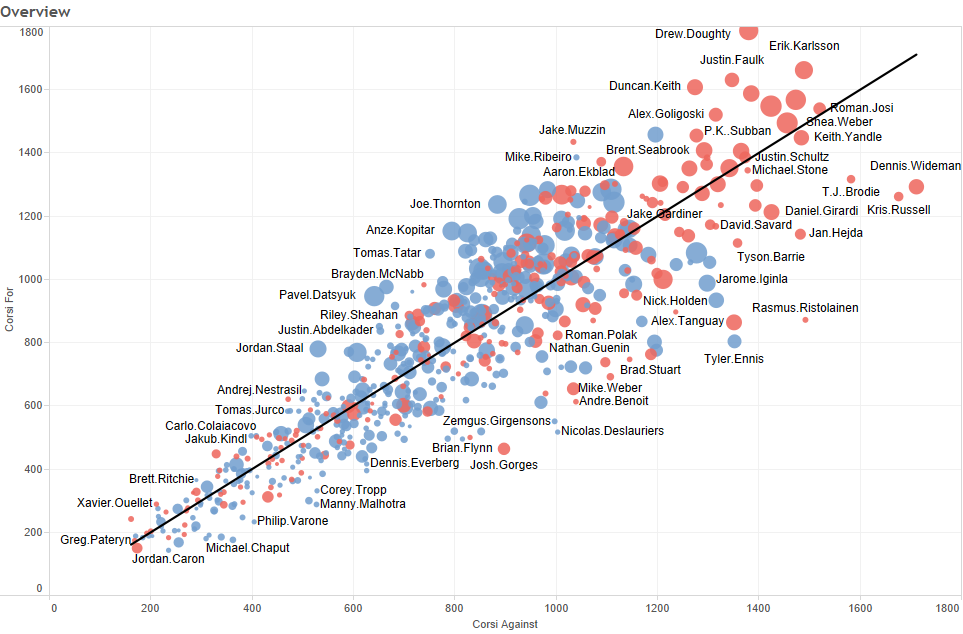
Thanks to war-on-ice.com, I was able to analyze the relationship between Corsi values (shots taken for/against while on the ice/off the ice) and annual contract values for players.  First, I map the Corsi for (herein CF) and Corsi against (herein CA) values on a (x,y) plot.  The size of the bubbles (for each player) are relative to the value of their contract.

Overview

Continue reading “Contracts and Corsi”

What does different fantasy football scoring look like?

It’s the week before the Super Bowl and that means that fantasy football has been concluded for over a month.  The spell has been broken on the cyclical ritual of getting amped about your roster and then massively disappointed after the 1 o’clock games.  The off-season gives us the chance to reflect on the good and bad decisions made throughout the course of the season.

If you have managed a fantasy football for multiple years, the off-season gives you a chance to contemplate any tweaks that need to be done to league scoring.  I have long thought about changing from standard scoring to PPR, but it was a concern about what it would do to alter the weights of each position.  For fantasy football aficionados, the PPR vs. standard scoring remains a point of contention, in which both sides are stalwart in their defense of their scoring preference.  For those less familiar with this debate, there are a few important key points.

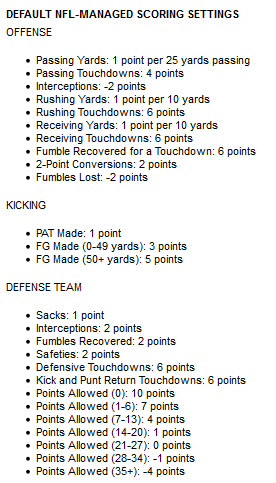
Standard fantasy football scoring is the set of default scoring preferences used by popular fantasy football platforms, such as ESPN, NFL.com and CBS.  Typical default settings look something like this:

Default scoring
Source:  http://www.nfl.com/fantasyfootball/help/nfl-scoringsettings

Continue reading “What does different fantasy football scoring look like?”